
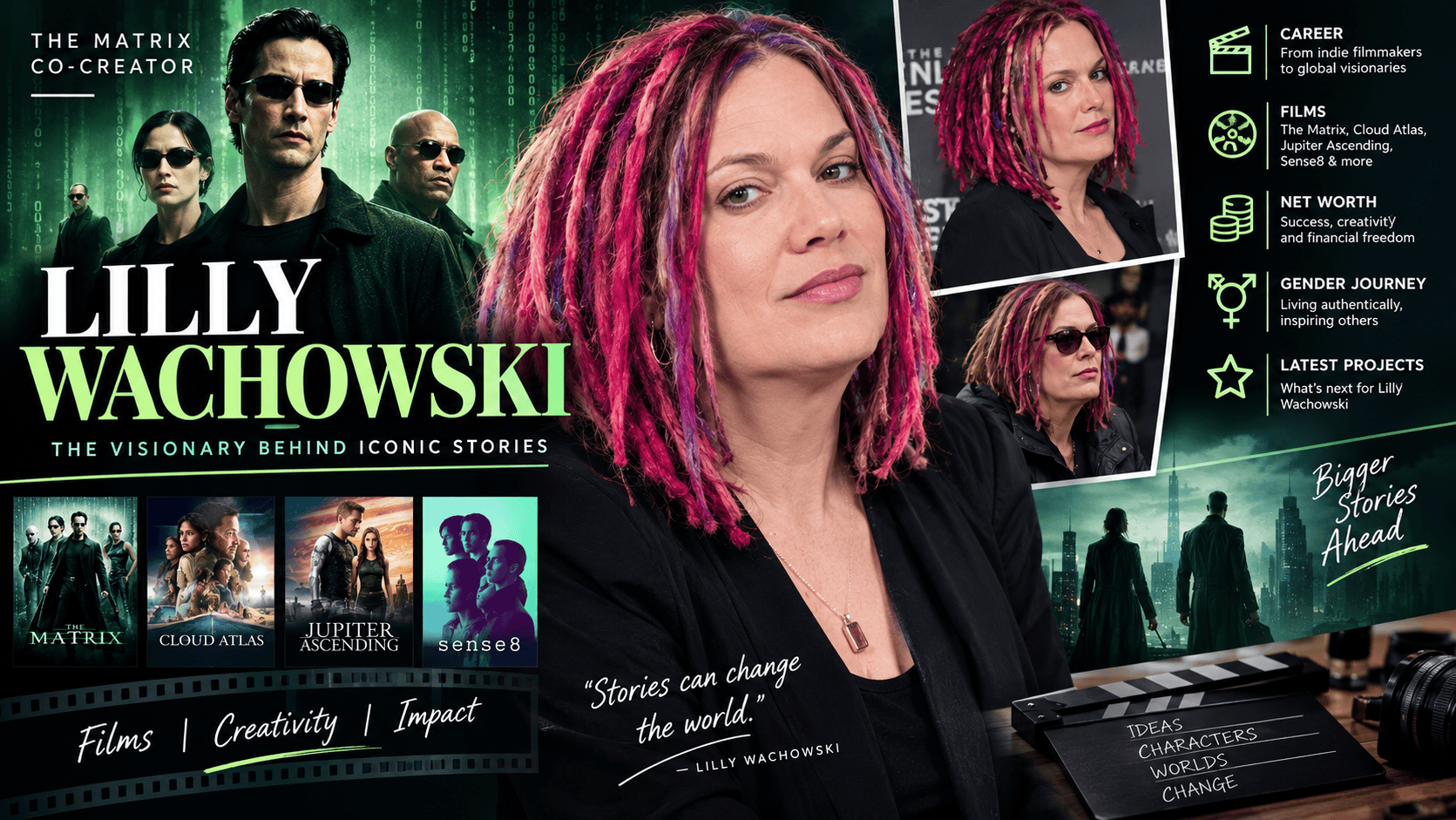

Lilly Wachowski is an American filmmaker, screenwriter, and producer best known for co-creating The Matrix franchise with her sister, Lana Wachowski. Her work has helped shape modern science fiction through innovative visual storytelling, philosophical questions about reality, and narratives exploring identity, freedom, and social power. Beyond blockbuster filmmaking, she has contributed to television, independent film, and projects that broaden representation in entertainment.
In 2026, her career has entered another interesting chapter. Alongside reflecting on the legacy of films such as Bound and The Matrix, she has discussed challenges facing filmmakers whose projects center transgender characters and marginalized communities. She is also helping develop Anarchists United, an artist-led nonprofit initiative intended to support independent film and television projects.
Understanding her story means looking beyond one famous franchise. Her career illustrates how creative risk, long-term collaboration, and a willingness to challenge established storytelling conventions can influence both popular culture and the film industry.
Who Is Lilly Wachowski?
Lilly Wachowski was born on December 29, 1967, in Chicago, Illinois. She grew up in a family that included her mother, Lynne, a nurse and painter, and her father, Ron, a businessman. She later attended Emerson College in Boston but left before completing her studies. She subsequently worked with her sibling Lana on creative projects before the pair established themselves in Hollywood.
Her professional identity developed through writing, directing, and producing rather than through a conventional film-school path. Early experience with comic books and storytelling helped build the foundation for the complex fictional worlds that became a signature of the Wachowskis’ work. Their films often combine action with questions about social systems, technology, personal identity, and the nature of reality.
Although audiences frequently associate her name with The Matrix, her filmography spans crime thrillers, science-fiction epics, adaptations, and television. That range is important because it shows a filmmaker interested not just in spectacle but also in how genre can be used to examine human experience.
Lilly Wachowski’s Career With Lana Wachowski

Lilly and Lana Wachowski developed a distinctive creative partnership that brought together ambitious concepts, carefully choreographed action, and unconventional narrative structures. Their first feature as directors was Bound (1996), a crime thriller that received positive critical attention for its tightly constructed story and stylish execution. The film helped establish their ability to work within familiar genres while challenging audience expectations.
Their breakthrough arrived with The Matrix in 1999. Its combination of cyberpunk aesthetics, martial arts, philosophical ideas, and groundbreaking visual effects became influential far beyond cinema. The film’s success gave the filmmakers greater creative influence and led to sequels, additional projects, and opportunities to explore more ambitious worlds.
Their collaboration also extended to projects such as Speed Racer, Cloud Atlas, Jupiter Ascending, and Sense8. Not every production received the same critical or commercial response, but the body of work demonstrates a consistent interest in large-scale ideas and unconventional storytelling. Their careers also show how creative partnerships can develop over decades while evolving in response to changing personal experiences.
The Matrix and Its Lasting Cultural Impact

The Matrix follows Neo, a computer programmer who discovers that the world he experiences is not what it appears to be. The story combines a science-fiction premise with questions about control, knowledge, and individual freedom. Its famous red-pill and blue-pill choice became a cultural reference point because it dramatizes the tension between accepting a comfortable reality and confronting an unsettling truth.
The film also changed expectations for action filmmaking. Its wire-assisted martial arts, carefully designed fight choreography, slow-motion effects, and stylized cinematography influenced later movies, television, games, and advertising. Yet its importance is not limited to technical innovation: the story invites viewers to question systems that shape their choices and perceptions.
In later interviews, Wachowski has discussed the film’s meanings and the ways audiences have interpreted or appropriated its imagery. In a 2026 interview, she criticized the political appropriation of the red-pill and blue-pill concept by extremist movements. That response highlights an important distinction: a story’s cultural afterlife can move far beyond the intentions of its creators.
Major Movies and Television Projects

The Wachowskis’ filmography includes several projects that demonstrate how their creative interests have evolved. The following table highlights major works and why they matter to Lilly’s career.
| Film or series | Year | Significance |
|---|---|---|
| Bound | 1996 | Crime thriller that established the sisters as feature-film directors |
| The Matrix | 1999 | Landmark science-fiction film with major cultural influence |
| The Matrix Reloaded | 2003 | Expanded the franchise’s mythology and philosophical themes |
| The Matrix Revolutions | 2003 | Concluded the original trilogy’s central conflict |
| V for Vendetta | 2005 | Political dystopian story; the Wachowskis wrote and produced the film |
| Speed Racer | 2008 | Visually ambitious adaptation of the Japanese racing franchise |
| Cloud Atlas | 2012 | Interconnected narratives exploring history, identity, and consequences |
| Jupiter Ascending | 2015 | Original space-opera adventure |
| Sense8 | 2015–2018 | Science-fiction television series centered on eight mentally connected strangers |
| Work in Progress | 2019 onward | Comedy series for which Lilly served as a writer and showrunner |
These projects reveal a recurring interest in characters who challenge their circumstances and discover unexpected connections with others. The approach varies by genre: Bound uses suspense and crime conventions, while Cloud Atlas links different eras through a sprawling narrative. Sense8 makes emotional connection and shared experience central to its science-fiction premise.
The commercial performance of these works has varied, but box-office results alone do not explain their cultural significance. Some films that initially divided critics have developed dedicated audiences, while others have influenced visual style, genre conventions, and conversations about representation.
Lilly Wachowski’s Gender Journey and Representation in Film

Wachowski publicly came out as a transgender woman in March 2016, following her sister Lana, who had publicly come out as transgender several years earlier. Her announcement brought renewed attention to the relationship between personal identity and the themes of transformation, authenticity, and freedom that appear throughout their work.
It is important, however, to avoid reducing her entire career to her gender identity. She is an accomplished filmmaker whose work existed long before her public announcement and continues to evolve beyond it. Her experience has also informed her public advocacy for greater opportunities for transgender artists and other underrepresented creators in film and television.
The discussion around The Matrix has become particularly complex. Some viewers interpret its ideas about awakening, conformity, and living within a constructed reality through a transgender lens. Wachowski has discussed how her and Lana’s experiences as closeted transgender women influenced their perspective, while also noting that audiences can interpret a film in many different ways.
Awards, Recognition, and Filmmaking Style
Wachowski’s work has received recognition from film festivals and genre-focused awards organizations. The Wachowskis shared major accolades and nominations connected to The Matrix and Bound, including recognition from the Saturn Awards, Hugo Awards, and other film organizations. These honors reflect the impact of their collaborative work rather than a separate award record for every individual contribution.
Her filmmaking style often blends elaborate world-building with questions about systems of power. Strong visual motifs, carefully designed action sequences, unconventional narrative structures, and philosophical ideas recur throughout her projects. In practical terms, this means the visual effects are rarely the only attraction: they help communicate a story’s ideas about freedom, identity, and the relationship between individuals and larger institutions.
Her career also illustrates a challenge for filmmakers working on expensive productions. Original concepts can be artistically ambitious but commercially risky, particularly when they require substantial budgets and unfamiliar worlds. The response to Jupiter Ascending, for example, differed sharply from the enduring influence of The Matrix. That contrast underscores how artistic ambition and commercial reception do not always move together.
Lilly Wachowski’s Latest Projects and Anarchists United

In 2026, Wachowski has been discussing new approaches to independent filmmaking and the obstacles facing projects with transgender-led stories. Entertainment Weekly reported that her screenplay The Hunted, co-written with her partner, features an entirely transgender cast and has struggled to secure studio financing despite positive responses from some industry professionals. She responded by organizing a live screenplay reading rather than allowing the project to remain unrealized.
She has also been helping lead Anarchists United Foundation, an artist-run nonprofit initiative intended to support independent films and television, particularly projects that represent marginalized communities. The approach seeks to create opportunities outside traditional studio financing, with a focus on lower-budget productions. This is a significant development because access to funding often determines which stories make it from script to screen.
For independent creators, the broader lesson is that a project does not have to follow the traditional studio route to reach an audience. Readings, festival presentations, nonprofit funding, and partnerships can help filmmakers develop work when conventional financing is difficult to obtain. These alternatives do not eliminate the challenges of distribution or production, but they can create additional paths for stories that might otherwise be overlooked.
What Is Lilly Wachowski’s Net Worth?
There is no consistently verified public financial statement establishing Wachowski’s exact net worth. Celebrity websites sometimes publish estimates, but those figures should not be treated as confirmed unless they are supported by reliable financial disclosures. Her career includes major films, television work, writing, directing, producing, and other creative projects, but the details of her contracts, royalties, investments, and expenses are private.
A filmmaker’s earnings can come from several sources, including upfront production fees, screenplay payments, producer credits, residuals, and participation in a project’s revenue. These arrangements differ considerably between productions, and a film’s box-office total does not reveal how much an individual filmmaker personally received.
For this reason, the most trustworthy approach is to describe her professional achievements without assigning an unsupported dollar figure to her wealth. Her influence on film history and her continuing creative work can be assessed through documented projects and public interviews rather than speculative financial estimates.
Frequently Asked Questions
What is Lilly Wachowski famous for?
Lilly Wachowski is best known for co-creating The Matrix franchise with Lana Wachowski. She has also worked on Bound, Cloud Atlas, Speed Racer, Jupiter Ascending, and the television series Sense8 and Work in Progress.
Is Lilly Wachowski related to Lana Wachowski?
Yes. Lana Wachowski is Lilly’s older sibling and longtime creative collaborator. Together, they directed and wrote several influential films, including The Matrix, and worked across film and television for decades.
When did Lilly Wachowski come out as transgender?
She publicly came out as a transgender woman in March 2016. Her announcement followed Lana Wachowski’s earlier public coming-out and prompted renewed discussion of identity and representation in their work.
Did Lilly Wachowski direct all the Matrix movies?
Lilly and Lana Wachowski directed the original trilogy: The Matrix (1999), The Matrix Reloaded (2003), and The Matrix Revolutions (2003). They also co-created the franchise, although later entries have involved different creative teams.
What is Lilly Wachowski working on in 2026?
Recent reporting has highlighted her screenplay The Hunted, which features a transgender cast, and her involvement with Anarchists United Foundation, an artist-led nonprofit intended to support independent film and television projects.
What is Lilly Wachowski’s net worth?
Her exact net worth has not been reliably confirmed in public sources. Online estimates vary, and without transparent financial disclosures, they should be regarded as speculative rather than established fact.
Conclusion
Lilly Wachowski’s career extends well beyond the success of The Matrix. From the crime thriller Bound to ambitious projects such as Cloud Atlas and Sense8, her work has repeatedly challenged conventional storytelling and explored questions about identity, freedom, technology, and human connection.
Her recent efforts to support independent filmmaking add another dimension to that legacy. By pursuing projects that struggle to find traditional studio financing and helping create opportunities for underrepresented artists, she is addressing not only what stories get told but also who gets the chance to tell them.
The lasting insight from her career is that influential filmmaking combines imagination with a willingness to challenge established systems. Whether through a groundbreaking science-fiction film or a smaller independent project, Wachowski continues to explore how cinema can question the world audiences inhabit and imagine possibilities beyond it.