
Introduction
Rob Reiner was an American actor, film director, producer, screenwriter, and political activist whose career spanned nearly six decades. He became famous as Michael “Meathead” Stivic on the television sitcom All in the Family, then established himself as one of Hollywood’s most successful directors through films such as The Princess Bride, When Harry Met Sally…, Stand by Me, and A Few Good Men.
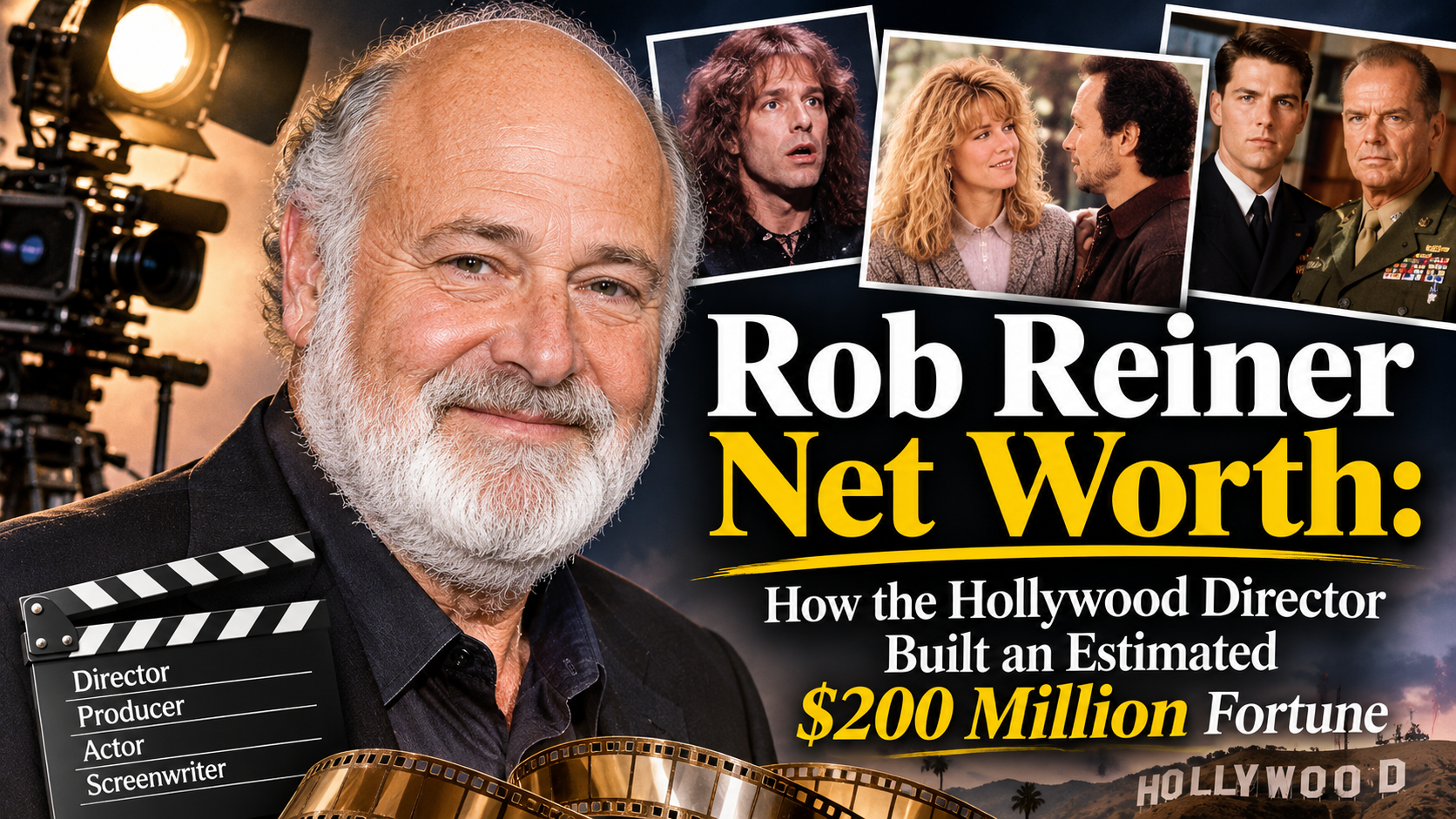
At the time of his death on December 14, 2025, Rob Reiner net worth was widely estimated at approximately $200 million. This figure is an industry estimate, not a publicly verified accounting of his assets or estate. His wealth reflected decades of acting, directing, producing, company ownership, entertainment rights, and real estate investments.
Reiner’s financial story is particularly interesting because he did not depend on acting salaries alone. His move into directing and his role in co-founding Castle Rock Entertainment gave him opportunities to participate in the business side of Hollywood, where successful film and television projects can generate value long after their original release.
What Was Rob Reiner’s Net Worth at the Time of His Death?
The most frequently reported estimate places his fortune at around $200 million. Celebrity Net Worth published this figure, and entertainment publications including Parade repeated it following his death. However, neither a published estate inventory nor an independently audited personal balance sheet confirms that exact amount.
Understanding the difference between net worth and career earnings is important. Net worth represents the estimated value of assets after liabilities, while career earnings describe money received over time. A filmmaker’s wealth may include property, company interests, investments, royalties, and other rights, alongside cash and income from individual projects. Without access to private financial records, the $200 million figure should be treated as an approximate estimate rather than a precise estate valuation.
How Rob Reiner Made His Money
Reiner built his fortune through several connected areas of entertainment. His acting career provided early recognition and income, but directing and producing gave him access to larger projects and opportunities to participate in production businesses. His work also created a lasting catalogue of films and television programs that continued attracting audiences over many years.

The main sources behind the reported Rob Reiner net worth estimate include:
- Television acting: His role in All in the Family established his reputation and generated earnings.
- Film directing: Successful movies created opportunities for directing fees and production income.
- Production ownership: Castle Rock Entertainment gave him an important position in Hollywood’s business landscape.
- Television and film production: Projects such as Seinfeld and The Shawshank Redemption expanded the company’s influence.
- Real estate and investments: Property ownership and other assets contributed to his overall financial position.
The exact amount earned from each category has not been publicly disclosed. Consequently, it is more accurate to understand his wealth as the result of a long career and business ownership than to assign unsupported figures to individual movies.
All in the Family: The Television Role That Made Him Famous
Reiner’s first major breakthrough came through All in the Family, the influential CBS sitcom created by Norman Lear. He played Michael “Meathead” Stivic, the liberal son-in-law of Archie Bunker, portrayed by Carroll O’Connor. The show ran from 1971 to 1979 and became famous for addressing subjects such as politics, social divisions, discrimination, and changing American values.

His performance earned him two Primetime Emmy Awards for his supporting role. The recognition established him as a prominent television actor and opened doors to further opportunities in entertainment. His work on the series also demonstrated his ability to combine comedy with serious social commentary, a quality that would later become visible in his directing career.
Although acting helped establish his financial foundation, it was only one part of his eventual wealth. His transition from television performer to filmmaker allowed him to build a much broader career.
Film Directing and Hollywood Box Office Success
Reiner made his feature-film directing debut with This Is Spinal Tap in 1984. The mockumentary about a fictional British rock band became a cult classic and helped popularize a distinctive style of comedy that blended improvisation, satire, and documentary-style filmmaking.

He followed it with an extraordinary series of successful films. Stand by Me explored childhood friendship and growing up, The Princess Bride combined fantasy and romance, and When Harry Met Sally… became one of the most recognizable romantic comedies in cinema. He later directed the psychological thriller Misery and the courtroom drama A Few Good Men.
These films helped establish his reputation as a director who could work across genres. From comedy and romance to suspense and courtroom drama, he demonstrated an ability to connect with different audiences. Commercial success can strengthen a director’s earning potential through negotiated fees, producing arrangements, and future opportunities, although the precise financial terms of his individual film contracts remain private.
Castle Rock Entertainment and the Business Deal That Changed His Wealth
One of the most important parts of Reiner’s financial history was the creation of Castle Rock Entertainment in 1987. He co-founded the production company with Martin Shafer, Andrew Scheinman, Glenn Padnick, and Alan Horn. The business gave its founders a platform to develop films and television projects while participating in the production side of Hollywood.

Castle Rock became associated with major productions, including When Harry Met Sally…, A Few Good Men, The Shawshank Redemption, The Green Mile, and the television sitcom Seinfeld. The company helped establish a reputation for quality storytelling and commercially significant entertainment.
In 1993, Turner Broadcasting acquired Castle Rock. Contemporary reporting by the Los Angeles Times described the transaction as involving approximately $100 million in cash and another $100 million in assumed debt. The company also had an existing ownership structure, including Sony Pictures Entertainment’s 44% stake. This distinction matters because the acquisition value was not the same as the amount personally received by Reiner.
Alan Horn, one of the company’s founders, described its creative ambitions by saying it had become known for producing “the kinds of pictures Castle Rock has become known for in this community.” The statement reflects the company’s identity as a creative production business rather than simply a collection of commercial assets.
The Castle Rock transaction is often discussed as a major contributor to Reiner’s wealth. However, there is no reliable public breakdown establishing his personal proceeds, ownership percentage at closing, taxes, or final investment returns. It would therefore be misleading to assume that the entire acquisition price went directly into his personal fortune.
Seinfeld and the Long-Term Value of Television Production
Seinfeld is particularly important when discussing Castle Rock’s business history. The sitcom, created by Larry David and Jerry Seinfeld, became one of the most successful television comedies of its era. Castle Rock was its production company, giving the business an association with a television property that continued to have commercial value through syndication and distribution.

Successful television programs can generate income for years after their original broadcasts. Syndication, licensing, international distribution, streaming agreements, and home entertainment releases can all contribute to a programme’s commercial life. This is one reason television production can be financially attractive compared with projects that earn most of their revenue during an initial theatrical release.
However, the value generated by Seinfeld should not be confused with Reiner’s personal earnings. Castle Rock’s corporate ownership, distribution agreements, rights arrangements, and other financial interests were separate from his individual finances. The contribution of the show to his fortune cannot be accurately calculated from public information alone.
Real Estate, Assets, and Other Financial Interests
Real estate has also been discussed in reports about the Rob Reiner net worth estimate. He and his wife, Michele Singer Reiner, were associated with properties in desirable Los Angeles locations, including Brentwood and Malibu. These areas have historically commanded high property prices because of their location, privacy, and access to the entertainment industry.
Celebrity Net Worth has discussed property holdings as part of its estimate of Reiner’s wealth. However, reported property values are not equivalent to verified equity. Mortgages, ownership arrangements, maintenance costs, taxes, and market changes all influence the actual financial value of real estate. Without property records and a complete balance sheet, precise figures should be treated cautiously.
Other potential sources of wealth included entertainment-related investments, production interests, and income from his extensive professional catalogue. These assets can be difficult to value because private agreements and ownership arrangements are not always publicly disclosed.
Rob Reiner’s Death and the Financial Legacy He Left Behind
Rob Reiner died on December 14, 2025, at the age of 78. His wife, Michele Singer Reiner, also died that day. Their deaths were widely reported as a major loss for the entertainment industry, with tributes highlighting Reiner’s contributions as an actor, director, producer, and activist.
Following his death, public interest in his fortune increased, particularly around the reported $200 million estimate and the future of his estate. However, an estimated net worth is not the same as a final probate valuation. The estate’s assets, liabilities, ownership structures, legal expenses, and eventual distributions would need to be assessed separately before its exact value could be established.
His financial legacy is therefore connected to more than the money he accumulated. It also includes the production company he helped establish, the films he directed, and the entertainment catalogue that continues to reach new audiences.
Awards, Recognition, and His Influence on Hollywood
Reiner’s professional recognition included two Emmy wins for All in the Family, alongside nominations and honors for his later work. His films became part of popular culture, while The Princess Bride, Stand by Me, and When Harry Met Sally… developed lasting audiences across generations.
His work also extended into documentary filmmaking. He directed and produced Albert Brooks: Defending My Life, which received Emmy recognition in 2024. In 2026, the Television Academy also recorded a posthumous Emmy win for his guest appearance in The Bear. These honors demonstrate the breadth of his work across acting, directing, and producing.
Beyond entertainment, Reiner supported early childhood education, marriage equality, and other civic causes. His involvement in California’s First 5 initiative reflected an interest in public policy and children’s development. His legacy therefore combines creative achievements with a long history of public advocacy.
Read More: SMH Stock Explained: VanEck Semiconductor ETF Holdings, Performance, Risks, and Investment Outlook
Frequently Asked Questions
What was Rob Reiner net worth when he died?
His fortune was widely estimated at approximately $200 million when he died in December 2025. This estimate, published by Celebrity Net Worth and repeated by entertainment outlets, is not an audited statement of his personal assets or estate.
How did Rob Reiner become so wealthy?
He accumulated wealth through television acting, film directing, producing, and business ownership. His role in All in the Family established his career, while his successful movies and co-founding of Castle Rock Entertainment created additional opportunities for long-term financial growth.
Did Rob Reiner own Castle Rock Entertainment?
Yes. He co-founded Castle Rock Entertainment in 1987 with four other partners. Turner Broadcasting acquired the company in 1993, although its ownership structure included other investors, so the acquisition price should not be confused with Reiner’s personal proceeds.
Did Rob Reiner make money from Seinfeld?
Castle Rock Entertainment was the production company behind Seinfeld, one of television’s most successful sitcoms. Reiner’s connection to the company placed him within an important entertainment business, but the exact amount of personal income or royalties he received from the series has not been publicly established.
What were Rob Reiner’s most successful movies?
His best-known films include This Is Spinal Tap, Stand by Me, The Princess Bride, When Harry Met Sally…, Misery, A Few Good Men, The American President, and The Bucket List. These productions helped establish his reputation as one of Hollywood’s most versatile directors.
Was Rob Reiner richer because of acting or directing?
His early acting career created recognition and income, but directing, producing, and business ownership expanded his opportunities considerably. Castle Rock was especially important because it gave him a role in the production business rather than limiting his earnings to individual acting or directing assignments.
Was the $200 million estate value officially confirmed?
No publicly available audited estate inventory confirms that exact amount. The $200 million figure is a widely reported estimate, and the final value of an estate can differ after debts, expenses, taxes, property valuations, and legal arrangements are considered.
Conclusion
Rob Reiner net worth was widely estimated at approximately $200 million at the time of his death, reflecting a remarkable career that combined acting, filmmaking, production ownership, and other financial interests. His role in All in the Family brought him early fame, while movies such as The Princess Bride, When Harry Met Sally…, and A Few Good Men established his reputation as a major Hollywood director.
The creation and eventual sale of Castle Rock Entertainment added another important dimension to his financial story. His association with Seinfeld and other successful productions demonstrated how ownership and participation in entertainment businesses can create value beyond individual film salaries.
Ultimately, his financial legacy is best understood through the combination of creative success and business decisions. The reported $200 million figure offers a useful estimate, but his lasting contribution is the collection of films and television productions that continue to influence audiences and filmmakers.