Introduction
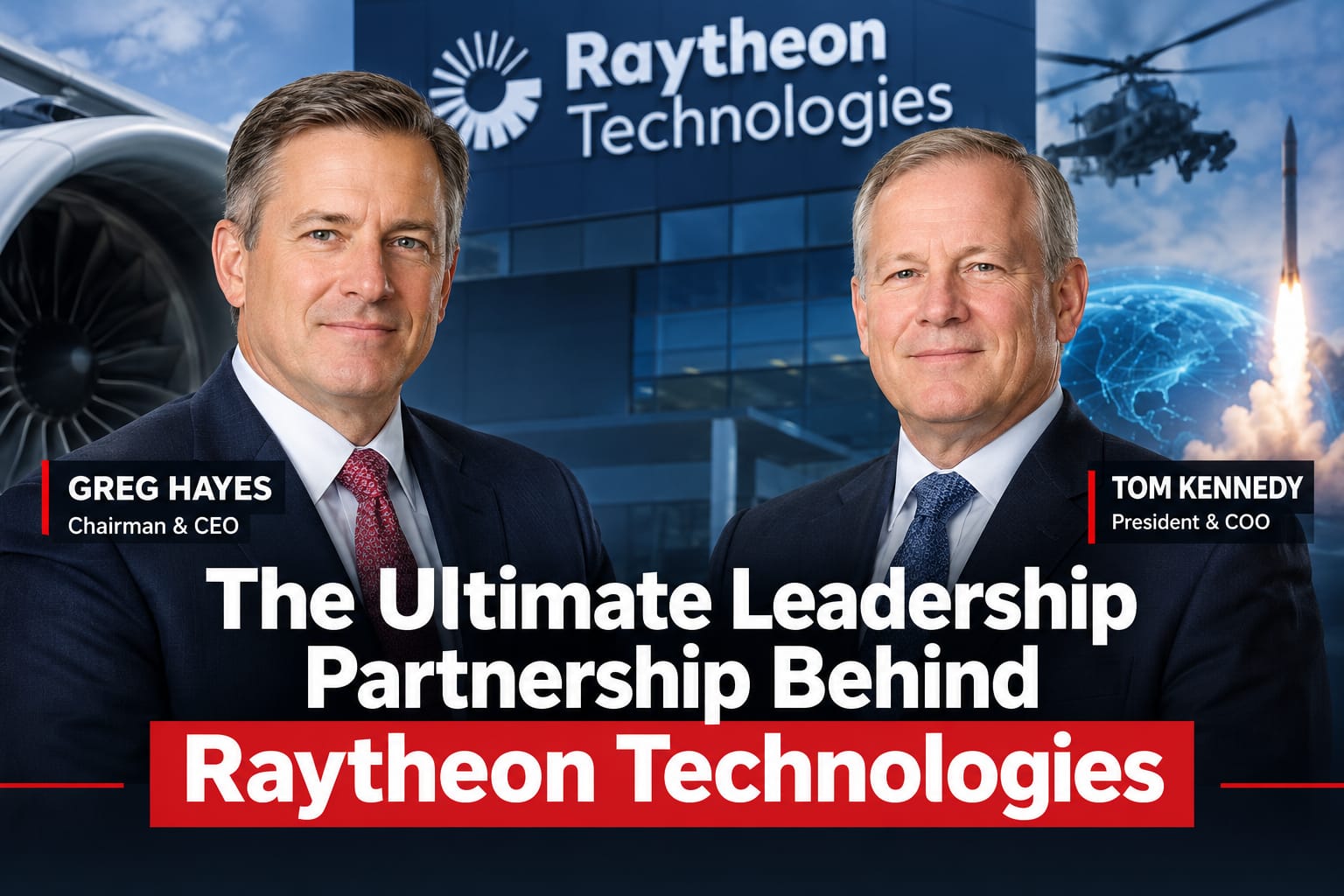
Greg Hayes and Tom Kennedy are the two executives most closely associated with the 2020 merger of United Technologies Corporation (UTC) and Raytheon Company—the transaction that created Raytheon Technologies, now known as RTX. Hayes, then CEO of UTC, and Kennedy, then chairman and CEO of Raytheon, structured a deal that combined complementary aerospace and defense portfolios while avoiding significant overlap in their core product lines. The agreement also included a carefully sequenced leadership transition: Kennedy would serve as executive chairman for one year, after which Hayes would add the chairman title to his CEO role.
Understanding how Greg Hayes and Tom Kennedy negotiated, executed, and then handed off control provides a useful case study in merger integration and executive succession within the defense-industrial sector.
Key Facts at a Glance
| Detail | Information |
|---|---|
| Announcement date | June 9, 2019 |
| Merger completed | April 2020 |
| Combined company name | Raytheon Technologies (now RTX) |
| Ownership split | UTC shareholders ~57%; Raytheon shareholders ~43% |
| Pro-forma 2019 sales | Approximately $74 billion |
| Leadership plan | Kennedy as executive chairman; Hayes as CEO, adding chairman after two years |
| Kennedy’s retirement | Effective June 1, 2021 |
| Hayes’ expanded role | Chairman and CEO, June 2021 onward |
Sources: merger announcement and chairman transition filings
Who Are Greg Hayes and Tom Kennedy?
Greg Hayes: The Architect of UTC’s Transformation
Gregory J. Hayes became CEO of United Technologies in 2016, inheriting a sprawling industrial conglomerate that included elevators, heating and cooling systems, and aerospace businesses. During his tenure, Hayes executed a deliberate portfolio reshaping: he divested the Sikorsky helicopter division in 2015, acquired Rockwell Collins in 2018, and spun off Otis Elevator and Carrier into independent public companies in April 2020. By the time the Raytheon merger closed, Hayes had converted UTC from a diversified industrial manufacturer into a focused aerospace and defense supplier—the strategic foundation that made the combination with Raytheon logical.
Tom Kennedy: A Raytheon Lif er and Defense Technologist
Thomas A. Kennedy joined Raytheon in 1983 and spent 38 years with the company, rising through executive and leadership positions before serving as chairman and CEO of Raytheon Company for six years prior to the merger. With a doctorate and a background in engineering and defense technology, Kennedy represented continuity and deep customer knowledge on the defense side of the combined business. His role as executive chairman during the first year after closing was designed to preserve that institutional expertise through the integration period.
How the Merger Came Together
The deal did not begin as a formal auction or banker-driven process. According to accounts from both executives, Kennedy initiated the conversation. He called Hayes in early summer 2018 after Hayes had announced plans to separate UTC’s Carrier and Otis businesses. Kennedy recognized that the remaining UTC aerospace business—Pratt & Whitney and Collins Aerospace—would resemble Raytheon in structure: platform-agnostic, franchise-rich, and complementary rather than overlapping. Hayes was initially occupied with the Rockwell Collins acquisition and the portfolio separations, but by late 2018 he agreed to begin discussions. Teams were engaged by January 2019, and the all-stock merger was unveiled on June 9, 2019.
Strategic Logic: “Platform-Agnostic” and Low Overlap
The central strategic argument advanced by both Hayes and Kennedy was that the two companies did not compete directly. Raytheon brought missile systems, integrated defense, and intelligence, surveillance, and reconnaissance capabilities; UTC brought aircraft engines, avionics, and aerospace systems through Pratt & Whitney and Collins Aerospace. The combined company would be “platform-agnostic,” meaning it would supply technology and subsystems across multiple prime contractors rather than being tied to a single aircraft or weapons platform. This structure was intended to reduce antitrust concerns and appeal to the Pentagon’s preference for supplier diversity at the subsystem level.
The Leadership Succession Plan
The merger agreement included an explicit, time-bound succession arrangement. Kennedy would become executive chairman of Raytheon Technologies upon closing. Hayes would serve as CEO and then assume the additional role of chairman two years after the transaction’s completion. In practice, Kennedy retired earlier than the full two-year window: Raytheon Technologies announced on April 26, 2021, that Kennedy would retire effective June 1, 2021, following the one-year anniversary of the merger. The board appointed Hayes to the chairman role at that time.
Timeline of the Hayes–Kennedy Transition
| Date | Event |
|---|---|
| Early summer 2018 | Kennedy calls Hayes to propose exploring a combination |
| January 2019 | Integration teams begin formal work |
| June 9, 2019 | All-stock merger announced |
| April 2020 | Merger closes; Kennedy becomes executive chairman; Hayes becomes CEO |
| April 26, 2021 | Company announces Kennedy’s retirement effective June 1, 2021 |
| June 1, 2021 | Hayes assumes chairman and CEO roles; Kennedy retires |
Sources: executive interviews and company announcements
What Each Executive Brought to the Integration
Hayes: Portfolio Discipline and Capital Allocation
Hayes’ contribution to the merger extended beyond deal negotiation. The separation of Otis and Carrier—executed simultaneously with the Raytheon combination—created a cleaner, more focused aerospace and defense company with a simpler capital structure. The merger announcement projected approximately $1 billion in gross annual run-rate cost synergies by year four and $18 billion to $20 billion of capital returns to shareholders in the first three years. Hayes’ prior experience transforming UTC gave him credibility with investors and the board as the executive best positioned to deliver on those integration targets.
Kennedy: Defense Customer Continuity and Technical Depth
Kennedy’s value during the transition year was less about deal mechanics and more about preserving relationships and technical continuity on the Raytheon side. As executive chairman, he provided the board and management team with direct access to decades of experience in missile systems, integrated air and missile defense, and classified customer programs. His public statements at the time of retirement emphasized the “partnership with Greg and his talented management team” and confidence in the combined company’s ability to “redefine the future of aerospace and defense”.
Expert Perspective: What This Leadership Handoff Demonstrates
The Hayes–Kennedy arrangement illustrates a model that is uncommon in large industrial mergers: a deliberate, publicly disclosed CEO-to-chairman sequence with a fixed endpoint. Rather than leaving the post-merger leadership structure ambiguous, the parties committed in the merger agreement to a specific transition path. That clarity served two purposes. First, it gave investors and employees a predictable answer to the question of “who is in charge” during the integration. Second, it allowed Kennedy to function as a senior statesman and technical resource without creating a dual-CEO dynamic. When the transition was accelerated by one year, the board was able to execute the change without reopening the broader integration strategy—a sign that the original succession architecture had done its job.
Read More: Jenna Jameson Now: Wedding, New Show & AI Twin in 2026
Frequently Asked Questions
What was the relationship between Greg Hayes and Tom Kennedy?
They were the CEOs of the two merging companies—Hayes of United Technologies and Kennedy of Raytheon—and then served as CEO and executive chairman, respectively, of Raytheon Technologies during the first year after the merger closed. Their public statements and joint interviews describe the relationship as a partnership built around complementary portfolios and a shared integration agenda.
Who approached whom about the Raytheon–UTC merger?
Tom Kennedy approached Greg Hayes. Kennedy called Hayes in early summer 2018 after Hayes had announced plans to separate UTC’s Carrier and Otis businesses. Kennedy saw that the remaining UTC aerospace business would mirror Raytheon’s structure, and he proposed exploring a combination.
When did Tom Kennedy retire from Raytheon Technologies?
Tom Kennedy retired effective June 1, 2021, following the one-year anniversary of the merger’s closing. Raytheon Technologies announced his retirement on April 26, 2021.
Did Greg Hayes become chairman of Raytheon Technologies?
Yes. The board appointed Greg Hayes to chairman of the board in addition to his CEO role when Kennedy retired in June 2021. The original merger agreement had contemplated Hayes adding the chairman title approximately two years after closing, but the transition occurred after one year.
Are Greg Hayes and Tom Kennedy still with Raytheon Technologies (RTX)?
Tom Kennedy retired from Raytheon Technologies in June 2021. Greg Hayes continued as chairman and CEO of RTX following Kennedy’s departure. For the most current information on Hayes’ status, consult RTX’s official investor relations disclosures and leadership page.
Is the Tom Kennedy associated with Greg Hayes the same person as the Detroit Lions player?
No. The Tom Kennedy who partnered with Greg Hayes in the Raytheon–UTC merger is Thomas A. Kennedy, the former chairman and CEO of Raytheon Company. Tom Kennedy the Detroit Lions wide receiver is a different individual with no connection to the defense-industry merger.
Conclusion
The partnership between Greg Hayes and Tom Kennedy was defined by a single, high-stakes transaction and a disciplined handoff of authority. Kennedy initiated the conversation, Hayes shaped the portfolio and the integration plan, and together they executed a merger that created one of the largest aerospace and defense companies in the world. The succession architecture they agreed to—executive chairman for Kennedy, CEO then chairman for Hayes—provided the predictability that large mergers often lack. For business leaders studying post-merger leadership transitions, the Greg Hayes and Tom Kennedy arrangement offers a clear example of how to sequence authority, preserve technical continuity, and exit on a timetable that serves the combined company rather than individual egos.