Introduction
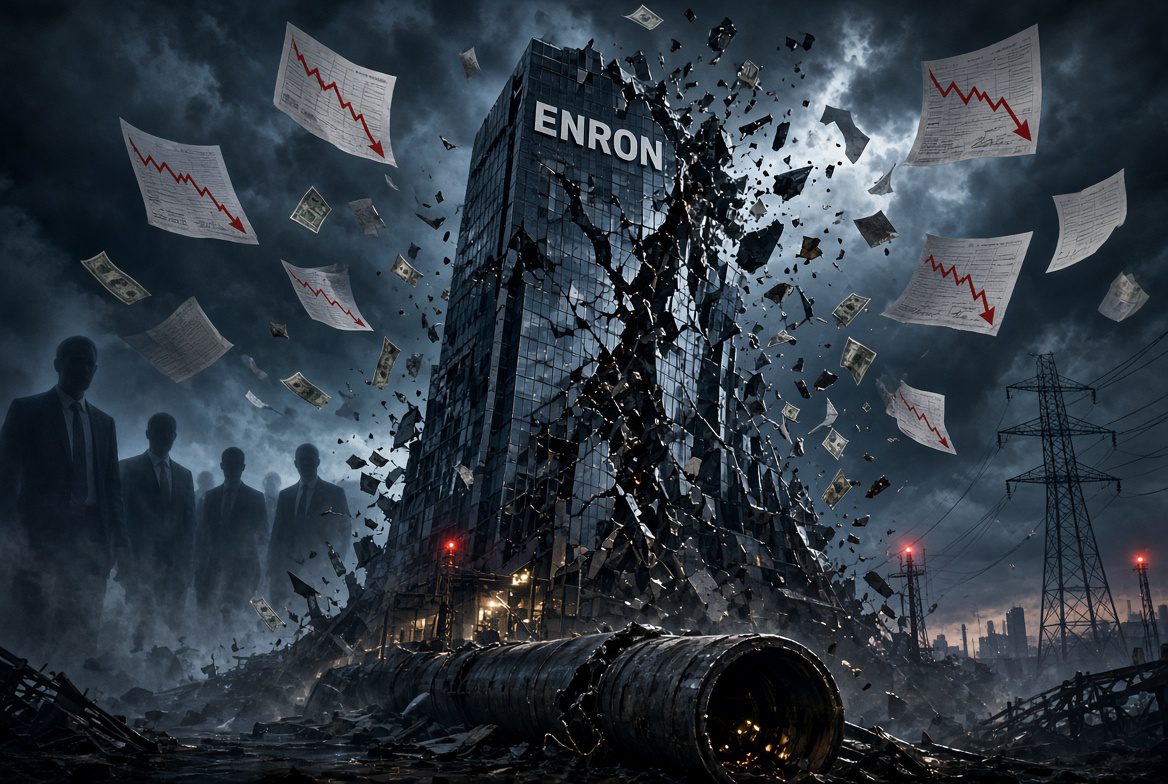
The Enron scandal remains the most notorious corporate fraud in American history. In December 2001, the Houston-based energy company Enron Corporation filed for Chapter 11 bankruptcy, wiping out $60 billion in shareholder value and costing thousands of employees their jobs and retirement savings. Just a year earlier, Enron’s stock had traded at over $80 per share; by the time the fraud was exposed, it was worth less than a dollar.
The Enron scandal was not a sudden failure but the result of years of systematic accounting fraud, concealed debt, and executive deception. Enron’s executives used complex financial structures to inflate profits artificially, mislead investors and regulators, and enrich themselves while the company’s actual financial condition deteriorated. When the truth emerged, it triggered the largest corporate bankruptcy in U.S. history at that time, destroyed the accounting firm Arthur Andersen, and led to sweeping regulatory reforms that reshaped corporate governance in America.
This article examines how the Enron scandal unfolded, the key figures involved, the accounting tricks used to conceal the fraud, and the lasting consequences that continue to influence corporate accountability today.
Key Facts About the Enron Scandal
| Fact | Detail |
|---|---|
| Company | Enron Corporation, Houston, Texas |
| Founded | 1986 (merger of Houston Natural Gas and InterNorth) |
| Peak Stock Price | $90.75 (August 2000) |
| Bankruptcy Filing | December 2, 2001 |
| Stock Value After Collapse | $0.26 per share |
| Shareholder Losses | Approximately $60 billion |
| Key Executives | Kenneth Lay, Jeffrey Skilling, Andrew Fastow |
| Auditor | Arthur Andersen (dissolved in 2002) |
| Major Legislation | Sarbanes-Oxley Act of 2002 |
The Rise of Enron: From Pipeline Company to Wall Street Darling
Enron was formed in 1986 through the merger of Houston Natural Gas and InterNorth, establishing itself as a major player in the natural gas pipeline business. Under the leadership of Kenneth Lay, who became CEO, the company expanded aggressively into energy trading and utilities.
In 1990, Lay hired Jeffrey Skilling, a former McKinsey & Company consultant, to run the newly created Enron Finance Corp. Skilling introduced a controversial accounting method called mark-to-market accounting, which allowed Enron to record projected future profits from long-term contracts as immediate revenue. This approach dramatically inflated reported earnings and made Enron appear far more profitable than it actually was.
By the late 1990s, Enron had become a global leader in energy trading, launching Enron Online in 1999 and expanding into broadband services and international markets. At its peak, Enron claimed annual revenues exceeding $150 billion and was consistently ranked among America’s most innovative companies. Fortune magazine named Enron “America’s Most Innovative Company” for six consecutive years.
However, beneath this facade of success, Enron was accumulating massive debts and hiding trading losses through increasingly complex financial structures.
The Key Players Behind the Enron Scandal
Kenneth Lay
Kenneth Lay served as Enron’s CEO and chairman for most of the company’s history. He was widely regarded as a visionary leader who transformed a regional pipeline company into a global energy trading powerhouse. Lay cultivated close relationships with politicians, including President George W. Bush, and was a major political donor.
After Skilling resigned in August 2001, Lay resumed the CEO role and attempted to secure government assistance and a merger with rival Dynegy to save the company. In May 2006, Lay was convicted on six counts of fraud and conspiracy. He died of a heart attack on July 5, 2006, before sentencing, and his conviction was subsequently vacated because he died before exhausting his appeals.
Jeffrey Skilling

Jeffrey Skilling joined Enron in 1990 and quickly rose through the ranks, becoming CEO in February 2001. He was the architect of Enron’s aggressive accounting practices and the driving force behind its transformation into a trading company. Skilling abruptly resigned in August 2001, citing “personal reasons,” just months before the fraud unraveled.
Skilling was convicted in May 2006 on 12 counts of securities fraud, one count of insider trading, conspiracy, and five counts of making false statements to auditors. He was sentenced to 24 years and four months in prison and ordered to forfeit approximately $45 million.
Andrew Fastow
Andrew Fastow served as Enron’s chief financial officer and was the mastermind behind the off-balance-sheet partnerships that concealed the company’s mounting debts. He created complex special purpose entities (SPEs) that allowed Enron to hide liabilities while appearing profitable.
Fastow was indicted on 78 counts of wire fraud, money laundering, and conspiracy. He pleaded guilty in January 2004 to two fraud counts and agreed to cooperate with prosecutors in exchange for a reduced sentence. He was sentenced to six years in prison.
How the Enron Fraud Worked
Special Purpose Entities (SPEs)
Enron used thousands of special purpose entities to move debt off its balance sheet. These SPEs were separate legal entities that Enron created and controlled but did not consolidate in its financial statements. By transferring assets and liabilities to these entities, Enron could conceal billions in debt from investors and regulators.
The most infamous of these entities were LJM Cayman and LJM2, named after Fastow’s wife and children. Fastow personally managed these partnerships, creating a massive conflict of interest since he was simultaneously Enron’s CFO and the manager of entities doing business with Enron.
Mark-to-Market Accounting
Enron used mark-to-market accounting to record projected future profits from long-term contracts as immediate revenue. This method required estimating the present value of future cash flows, which gave Enron enormous discretion to manipulate reported earnings. Enron could essentially book profits on contracts that might never generate actual revenue.
The SEC later alleged that Skilling and others “engaged in a wide-ranging scheme to defraud by manipulating Enron’s publicly reported financial results” through improper use of reserves within the wholesale energy trading business.
The Raptor Partnerships
Enron created a series of partnerships called Raptors that were used to hedge against losses in its own investments. These entities were supposed to protect Enron from declines in the value of certain assets. However, the Raptors were funded primarily with Enron’s own stock, creating a circular arrangement that would collapse if Enron’s stock price fell. When Enron’s stock declined, the Raptors failed, forcing Enron to reduce its assets by $1.01 billion to correct accounting errors.
Timeline of the Enron Collapse
| Date | Event |
|---|---|
| 1986 | Enron formed through merger of Houston Natural Gas and InterNorth |
| 1990 | Jeffrey Skilling hired to run Enron Finance Corp |
| August 2000 | Enron stock reaches all-time high of $90.75 |
| August 14, 2001 | Skilling unexpectedly resigns as CEO |
| October 16, 2001 | Enron announces $618 million third-quarter loss |
| October 22, 2001 | SEC launches formal inquiry into Enron’s finances |
| November 8, 2001 | Enron admits overstating profits by $586 million over five years |
| November 21, 2001 | Credit rating downgraded to “junk” status |
| November 28, 2001 | Dynegy merger collapses |
| December 2, 2001 | Enron files for Chapter 11 bankruptcy |
| January 2002 | Arthur Andersen admits destroying Enron documents |
| May 25, 2006 | Lay and Skilling convicted on fraud charges |
| October 23, 2006 | Skilling sentenced to 24 years in prison |
The Collapse and Bankruptcy
The Enron scandal unraveled rapidly in the autumn of 2001. After Skilling’s sudden resignation in August, the company’s stock price began a steep decline. On October 16, 2001, Enron reported a third-quarter loss of $618 million and disclosed a $1.2 billion reduction in shareholder equity.
On November 8, 2001, Enron announced it would restate its financial statements for 1997 through 2000, reducing previously reported net income by $586 million. This admission confirmed what many had suspected: Enron’s reported profits had been fabricated.
Credit rating agencies downgraded Enron’s debt to “junk” status on November 21, making it nearly impossible for the company to secure financing. A planned merger with rival Dynegy collapsed on November 28. Just days before filing for bankruptcy, Enron paid $55 million in bonuses to approximately 500 employees, with 11 executives receiving between $500,000 and $5 million each.
On December 2, 2001, Enron filed for Chapter 11 bankruptcy, listing $63.4 billion in assets. It was the largest corporate bankruptcy in U.S. history at that time. Approximately 4,000 employees were laid off immediately, and thousands more lost their jobs as the company was liquidated. Employees lost not only their jobs but also their 401(k) retirement savings, which were heavily invested in Enron stock.
The Fall of Arthur Andersen
Arthur Andersen, one of the “Big Five” accounting firms, served as Enron’s external auditor. The firm had been auditing Enron’s books since the company’s founding and also provided consulting services worth millions annually. This dual role—auditor and consultant—created a significant conflict of interest, as Andersen had financial incentives to maintain a profitable relationship with Enron rather than challenge questionable accounting practices.
When the SEC launched its investigation in October 2001, Andersen partners instructed employees to destroy Enron-related documents. The firm shredded approximately 20 boxes of documents, an act that led to criminal obstruction of justice charges. In June 2002, Arthur Andersen was convicted of obstruction of justice, effectively ending its operations. The firm surrendered its licenses to practice as certified public accountants, and its global network disintegrated.
Although the Supreme Court later overturned Andersen’s conviction on narrow technical grounds in 2005, the firm had already ceased operations, and its reputation was permanently destroyed.
Regulatory Aftermath: The Sarbanes-Oxley Act

The Enron scandal, along with the subsequent WorldCom scandal, prompted Congress to enact the most significant securities legislation since the 1930s. The Sarbanes-Oxley Act of 2002 (SOX) was signed into law on July 30, 2002, introducing sweeping reforms designed to enhance corporate transparency and accountability.
Key provisions of the Sarbanes-Oxley Act include:
- CEO and CFO Certification: Top executives must personally certify the accuracy of financial statements
- Auditor Independence: Accounting firms are prohibited from providing most consulting services to companies they audit
- Public Company Accounting Oversight Board (PCAOB): A new regulatory body was created to oversee the auditing profession
- Whistleblower Protections: Employees who report fraud are protected from retaliation
- Enhanced Penalties: Criminal penalties for securities fraud were increased significantly
The Sarbanes-Oxley Act fundamentally changed how public companies operate, requiring more rigorous internal controls and greater transparency in financial reporting.
The Impact on Employees and Investors
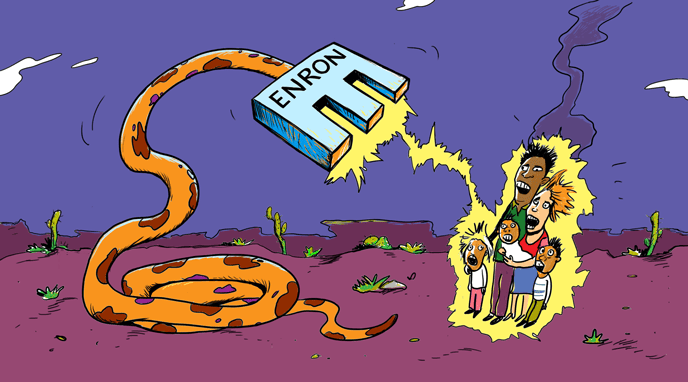
The human cost of the Enron scandal was devastating. Approximately 5,600 employees lost their jobs when the company collapsed. Many workers lost their life savings because their 401(k) retirement plans were heavily invested in Enron stock, which became virtually worthless.
Investors lost approximately $60 billion in shareholder value. The company’s stock, which had been trading at over $80 per share a year before the collapse, fell to $0.26. Retirees who had trusted Enron as a safe investment saw their retirement funds evaporate.
The Enron collapse also had broader economic effects. The scandal eroded public confidence in American corporations and financial markets, contributing to an economic downturn in 2002. It sparked investigations into other companies, including WorldCom, Tyco International, and Adelphia Communications, all of which faced similar accounting scandals.
Key Lessons from the Enron Scandal
The Enron scandal offers several enduring lessons for investors, regulators, and corporate leaders:
Beware of Complexity: Enron’s financial structures were intentionally opaque, designed to confuse analysts and regulators. When a company’s financial statements are difficult to understand, that itself can be a red flag.
Conflicts of Interest Matter: Arthur Andersen’s dual role as auditor and consultant created a conflict of interest that undermined its independence. The Sarbanes-Oxley Act now prohibits such arrangements.
Executive Compensation Can Create Perverse Incentives: Enron executives were rewarded for short-term stock performance, incentivizing them to manipulate earnings to meet Wall Street expectations.
Corporate Governance Is Essential: Enron’s board of directors failed to provide meaningful oversight, approving transactions that enriched executives at shareholders’ expense.
Whistleblowers Are Critical: Sherron Watkins, an Enron vice president, warned Kenneth Lay about accounting irregularities before the collapse. Her warnings were ignored, but her courage highlighted the importance of internal dissent.
Read More: Grocery Outlet Closing Stores: 36 Underperforming Locations Shut Down
FAQs About the Enron Scandal
What was the Enron scandal?
The Enron scandal was a major corporate fraud in which Enron executives used accounting tricks, special purpose entities, and false financial reporting to hide billions in debt and inflate profits. The fraud led to the company’s bankruptcy in December 2001 and the dissolution of its auditor, Arthur Andersen.
Who were the key figures in the Enron scandal?
The primary figures were Kenneth Lay (founder and CEO), Jeffrey Skilling (CEO), and Andrew Fastow (CFO). Lay and Skilling were convicted of fraud in 2006, and Fastow pleaded guilty and cooperated with prosecutors. Several other executives were also charged and convicted.
How much money was lost in the Enron scandal?
Investors lost approximately $60 billion in shareholder value, and Enron’s stock fell from over $80 per share to $0.26. Thousands of employees also lost their jobs and retirement savings.
What happened to Arthur Andersen?
Arthur Andersen, Enron’s auditor, was convicted of obstruction of justice in 2002 for shredding Enron-related documents. Although the conviction was later overturned, the firm had already collapsed, and its licenses were surrendered.
What was the Sarbanes-Oxley Act?
The Sarbanes-Oxley Act of 2002 is a federal law enacted in response to the Enron and WorldCom scandals. It introduced stricter financial reporting requirements, auditor independence rules, and criminal penalties for securities fraud.
Why is the Enron scandal still important today?
The Enron scandal fundamentally changed corporate governance and financial regulation in the United States. It led to the Sarbanes-Oxley Act, increased scrutiny of corporate accounting, and greater awareness of the risks of unchecked executive power and conflicts of interest.
Conclusion
The Enron scandal was more than a corporate failure; it was a watershed moment that exposed the vulnerabilities of American corporate governance and financial oversight. The company’s collapse in December 2001 destroyed billions in shareholder value, cost thousands of workers their livelihoods and retirement savings, and brought down one of the world’s most respected accounting firms.
The lessons of the Enron scandal continue to resonate. The Sarbanes-Oxley Act and subsequent regulations have strengthened corporate accountability, but the fundamental challenge of ensuring ethical leadership and transparent financial reporting remains. For investors, the Enron scandal serves as a reminder to scrutinize complex financial structures, understand potential conflicts of interest, and never assume that past success guarantees future integrity.
As a case study in corporate fraud and regulatory failure, the Enron scandal remains essential learning for business students, investors, and anyone interested in how unchecked power and unethical behavior can destroy even the mightiest corporations. The Enron scandal’s legacy is not just a cautionary tale but a call to maintain vigilance in protecting the integrity of financial markets.