
Introduction
Arm stock refers to shares of Arm Holdings plc (NASDAQ: ARM), the Cambridge-based semiconductor intellectual property company whose processor designs power most of the world’s smartphones and a growing share of data center servers. As of the October 22, 2026 close, ARM traded at $210.10, down 7.28% on the session, with a market capitalization of roughly $224.4 billion. The stock sits well below its 52-week high of $452.70 but remains above its 52-week low of $100.02, a range that reflects both intense AI enthusiasm and sharp valuation-driven corrections.
This article focuses exclusively on Arm Holdings plc. “Arm stock” can also be used in firearms-related contexts, but the dominant market and search meaning refers to the Nasdaq-listed semiconductor company.
Arm matters because it sits at the center of two structural shifts: the migration of cloud workloads to energy-efficient Arm-based CPUs, and the emergence of agentic AI, which places greater demands on CPU orchestration, memory management, and security. Those tailwinds have driven record revenue, but they also come with a valuation that leaves little room for execution errors.
What Is Arm Holdings?
Arm does not fabricate chips. It designs CPU architectures, graphics and neural processing IP, system IP, and pre-integrated compute subsystems, then licenses those designs to semiconductor companies and original equipment manufacturers. Customers—including Apple, Qualcomm, NVIDIA, Amazon Web Services, Google, Microsoft, and many others—integrate Arm technology into their own chips. Arm earns money in two primary ways:
- Licensing revenue: upfront or contracted fees for access to Arm’s architecture and design tools.
- Royalty revenue: a per-chip fee when a customer ships a product containing Arm technology.
This asset-light model has historically produced very high gross margins and substantial operating leverage. More recently, Arm has begun moving into production silicon with its Arm AGI CPU, a data center chip designed for agentic AI workloads. That shift expands Arm’s addressable market but also changes its risk profile, because selling chips is a lower-margin, more capital-intensive business than licensing IP.
Arm Stock Key Facts
| Metric | Detail |
|---|---|
| Ticker | NASDAQ: ARM |
| Share price (Oct 22, 2026 close) | $210.10 |
| Market capitalization | ~$224.4 billion |
| 52-week range | $100.02 – $452.70 |
| Trailing P/E | 214.45 |
| Forward P/E | ~88–95 |
| Price-to-sales (trailing) | 43.52 |
| Beta (5-year) | 3.79 |
| Dividend | None |
| Next earnings date | November 4, 2026 |
| Analyst consensus | Buy |
| Average price target | $290.71 |
Sources: stockanalysis.com, October 22–23, 2026.
The beta of 3.79 is a useful reminder: Arm stock is not a low-volatility holding. It has moved violently in both directions since its September 2023 IPO, and position sizing matters as much as the thesis itself.
Arm Stock Performance: A Boom-and-Bust Pattern
Arm’s post-IPO trading history has been defined by extreme swings. The stock surged through 2024 and 2025 on AI optimism, peaked at $452.70 within the past year, and then corrected sharply as investors reassessed valuation, smartphone royalty softness, and litigation risk. Even after that drawdown, the shares are still up meaningfully from their 52-week low.
The recent weakness has been driven by a combination of factors:
- Valuation compression: at more than 200 times trailing earnings, Arm was priced for near-flawless execution.
- Semiconductor sector volatility: broad selloffs in chip stocks have hit high-multiple names hardest.
- Qualcomm litigation: the jury verdict in October 2026 introduced uncertainty around future licensing negotiations, even though the damages award was nominal.
- Smartphone softness: handset royalties remain a large part of the business, and memory price inflation has pressured device volumes.
At the same time, the fundamental operating trends have remained strong. Revenue has grown more than 20% for three consecutive fiscal years, and data center royalties have become a genuine second growth engine.
How Arm Makes Money
Licensing: The Leading Indicator
Licensing revenue is the clearest signal of customer commitment to Arm’s roadmap. In the fourth quarter of fiscal 2026, licensing and other revenue reached $819 million, up 29% year over year. For the full fiscal year, licensing revenue rose 25% to $2.31 billion.
Annualized contract value, a measure of the value of signed licensing agreements, grew 22% year over year in Q4 FY2026. Management also signed additional Compute Subsystems agreements, including one for smartphone chips and one for data center networking silicon. These contracts matter because they typically precede years of royalty revenue.
Royalties: The Recurring Engine
Royalty revenue is tied to customer chip shipments. In FY2026, royalties rose 21% to $2.61 billion. In Q1 FY2027, royalty revenue grew 22% to $715 million, with data center royalties more than doubling year over year.
The mix is shifting. Smartphones still contribute the majority of royalty revenue, but data center, cloud AI, edge AI, and physical AI are growing faster. Arm’s Neoverse data center processor family has now shipped more than 1.5 billion cores, and Arm says it holds nearly 50% share among top hyperscaler cloud compute deployments.
Compute Subsystems and Higher Royalty Rates
Arm has been steadily increasing the value it captures per chip. The shift from individual IP blocks to pre-integrated Compute Subsystems allows customers to bring products to market faster, and those subsystems carry higher royalty rates. The transition from Armv8 to Armv9 has also raised the royalty rate per chip. These are quieter drivers than the AI headline, but they are important to the long-term revenue algorithm.
The AI Data Center Growth Story
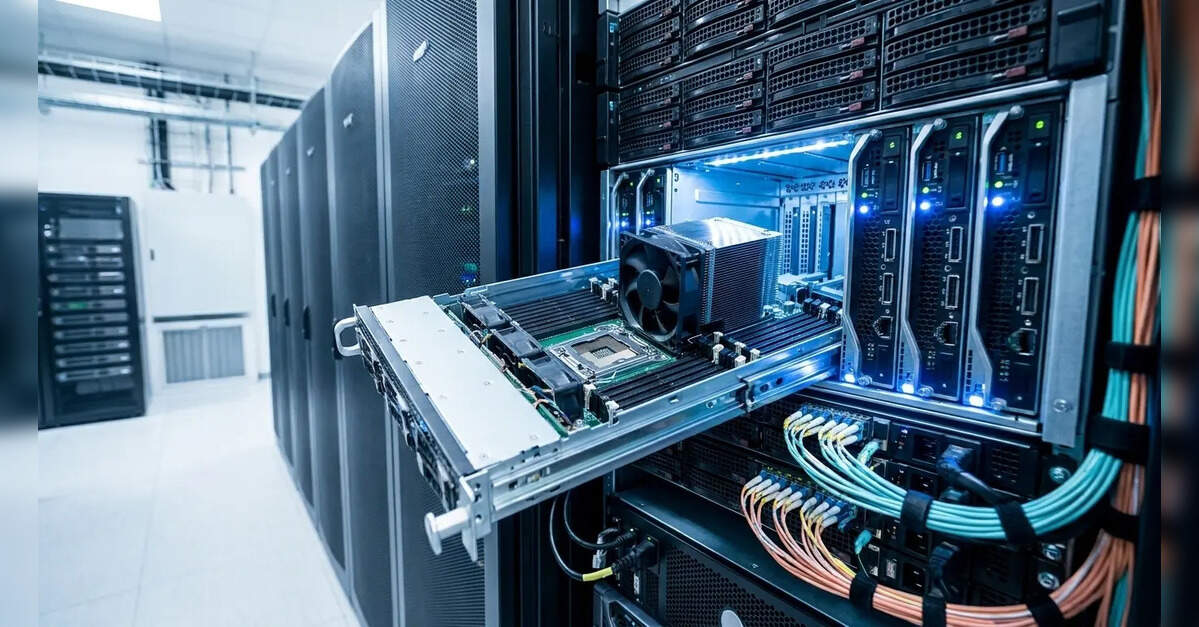
The core bull case for Arm stock is that data centers are migrating toward Arm architecture for power-efficient compute. Arm-based server CPUs now compete directly with x86 processors in cloud workloads, and hyperscalers have invested heavily in custom silicon built on Arm designs.
Several data points support the thesis:
- Data center royalty revenue more than doubled year over year in both Q4 FY2026 and Q1 FY2027.
- Google replaced x86 host processors with custom Arm-based Axion CPUs in TPU deployments, improving performance while lowering power consumption.
- Arm estimates that agentic AI workloads may require more than four times the current CPU capacity per gigawatt, and it sizes the data center CPU market opportunity at above $100 billion by 2030.
- Arm claims its AGI CPU delivers more than twice the performance per rack versus x86-based platforms and could reduce AI data center capital expenditure by up to $10 billion per gigawatt.
Those figures come from Arm management and should be treated as company projections, not independent forecasts. The direction of travel, however, is corroborated by hyperscaler adoption and the broader industry focus on performance-per-watt.
Arm AGI CPU: The $15 Billion Bet
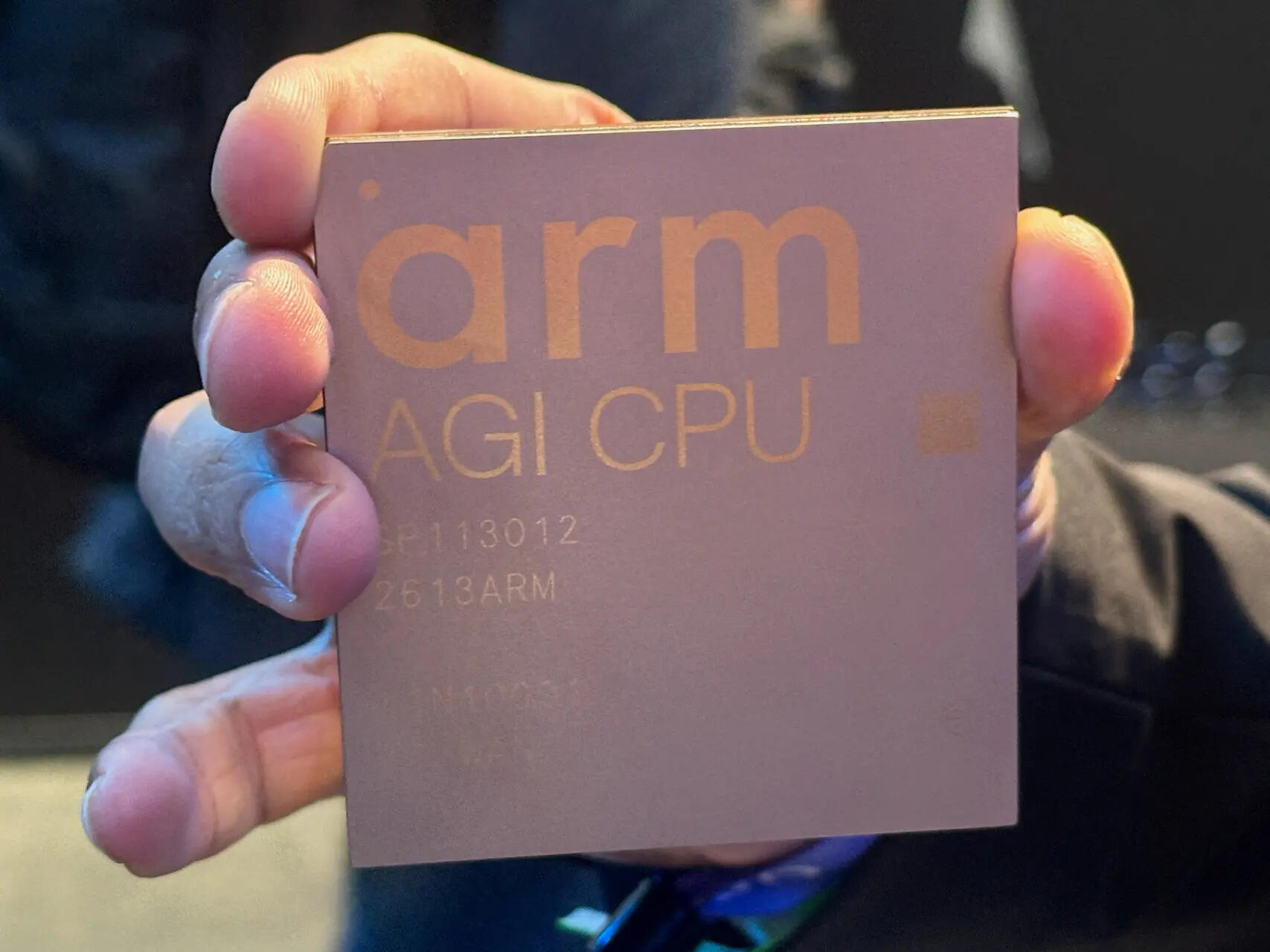
Arm’s move into producing its own data center silicon is the most consequential strategic development in the company’s recent history. The Arm AGI CPU is designed for agentic AI workloads—tasks where CPUs coordinate data movement, manage memory, enforce security, and orchestrate accelerators.
Management has disclosed that customer demand for the AGI CPU across fiscal 2027 and 2028 now exceeds $2 billion, more than double the level discussed at launch. Arm expects the AGI CPU business to generate $15 billion in annual revenue by fiscal 2031, contributing to a total revenue opportunity of $25 billion when combined with the IP business.
That is an ambitious target. It implies a business roughly three times the size of Arm’s entire FY2026 revenue. The near-term constraint is supply: Arm has secured capacity for only the initial $1 billion opportunity, and orders exceed available wafers and substrates. Execution on manufacturing, packaging, and customer deployment will determine whether the $15 billion target is credible or aspirational.
There is also a strategic tension. By selling its own chips, Arm moves from neutral IP supplier to potential competitor of its own customers. That could accelerate customer interest in alternatives, including RISC-V and in-house designs. Management argues that the AGI CPU expands the pie rather than cannibalizing licensing, but the market will watch customer behavior closely.
Financial Snapshot
| Metric | FY2024 | FY2025 | FY2026 | FY2027 Consensus |
|---|---|---|---|---|
| Revenue | $3.23B | $4.01B | $4.92B | ~$6.06B |
| Revenue growth | — | +24.1% | +22.8% | +23.1% |
| Licensing revenue | — | — | $2.31B | — |
| Royalty revenue | — | — | $2.61B | — |
| Non-GAAP EPS | — | — | $1.77 | ~$2.23 |
| Net income | — | — | $904M | — |
Sources: stockanalysis.com, Nasdaq, company reports.
In Q1 FY2027, Arm reported revenue of $1.29 billion, up 22% year over year, with net income of $270 million and adjusted EPS of $0.45, ahead of consensus. For Q2 FY2027, management guided revenue of $1.33 billion to $1.43 billion and adjusted EPS of $0.43 to $0.51.
The balance sheet remains conservative. Arm carries very low debt relative to equity, with a debt-to-equity ratio of 0.06 and a current ratio of 5.25. That gives the company flexibility to fund R&D, ecosystem development, and the AGI CPU ramp without relying on external financing.
Valuation: Priced for Perfection
Arm stock is not cheap on any conventional metric.
| Valuation Metric | Arm | Context |
|---|---|---|
| Trailing P/E | 214.45 | vs. semiconductor industry average in the 20s–30s |
| Forward P/E | ~88–95 | Based on FY2027 EPS estimates |
| Price-to-sales (trailing) | 43.52 | Well above most large-cap semiconductor peers |
| Forward price-to-sales | 34.54 | Reflects high growth expectations |
| EV/EBITDA | 207.77 | Extremely elevated |
| PEG ratio | 2.90 | Growth-adjusted valuation still rich |
Sources: stockanalysis.com.
The bull argument is that Arm’s earnings are artificially depressed by heavy investment in the AGI CPU and that margins will expand as revenue scales. The bear argument is that even after adjusting for growth, the stock discounts a decade of flawless execution.
A simple way to frame the debate: Arm’s forward P/E of roughly 90 implies that investors expect earnings to compound at a very high rate for several years. If revenue growth slows to the high teens and margins plateau, the multiple has room to compress significantly. If the AGI CPU ramps on schedule and data center royalties keep doubling, the earnings base could grow into the valuation.
Analyst Ratings and Price Targets
According to 43 analysts polled by S&P Global, Arm stock carries a consensus rating of Buy with an average 12-month price target of $290.71, implying roughly 38% upside from the October 22 close. The range is unusually wide: from $125 on the low end to $500 on the high end, a reflection of genuine disagreement about the durability of Arm’s growth and the appropriate multiple.
| Firm | Rating | Price Target | Date |
|---|---|---|---|
| Bernstein | Buy | $480 | Sep 15, 2026 |
| Piper Sandler | Buy | $320 | Sep 9, 2026 |
| Mizuho | Buy | $400 | Aug 25, 2026 |
| Raymond James | Buy | $272 | Aug 25, 2026 |
| Morgan Stanley | Hold | $212 | Sep 18, 2026 |
| Susquehanna | Buy | $320 | Oct 21, 2026 |
Sources: stockanalysis.com, TipRanks.
The dispersion matters more than the average. A $125 target and a $500 target cannot both be right about the same business over the next twelve months. The difference comes down to assumptions about AGI CPU execution, data center share gains, royalty rates, and the multiple investors are willing to pay for those earnings.
Risks to the Arm Stock Thesis
Qualcomm Litigation and Licensing Uncertainty
In October 2026, a Delaware jury found that Arm breached its architectural license agreement with Qualcomm and awarded Qualcomm $2 in nominal damages, while also finding for Arm on four of Qualcomm’s six claims. Both sides claimed victory. The more important issue is what happens next: a federal judge must decide whether Qualcomm can stop paying Arm royalties for five years, a outcome that could be worth billions of dollars.
Even a favorable ultimate outcome for Arm leaves near-term uncertainty. Licensing negotiations with other customers may become more contentious if Arm’s leverage is perceived to have weakened.
RISC-V and Customer Insourcing
RISC-V is an open-source instruction set architecture that competitors can use without paying Arm licensing fees. It has gained traction in automotive, embedded, and low-cost segments, and a group of Arm customers and competitors announced a joint venture in 2023 to accelerate RISC-V adoption. Arm’s move into selling its own chips could accelerate customer interest in RISC-V as a hedge against dependence on a supplier that is now also a competitor.
RISC-V is not yet a credible threat in high-performance data center CPUs, but it does not need to be. Erosion at the low end and in cost-sensitive markets can still pressure Arm’s royalty growth over time.
Smartphone Concentration
Despite the data center narrative, smartphones remain a major source of royalty revenue. Handset volumes are sensitive to memory prices, consumer demand, and macroeconomic conditions. In Q1 FY2027, management noted that smartphone softness remained a watch item even as data center growth accelerated. A prolonged handset downturn would slow overall royalty growth and make the data center ramp more important—and more exposed to execution risk.
Valuation and Volatility
At more than 200 times trailing earnings and a beta of 3.79, Arm stock is vulnerable to sharp drawdowns when sentiment shifts. The 52-week range of $100 to $452 illustrates the point. Investors who buy the thesis must be prepared for volatility that is well above the broad market.
AGI CPU Execution and Margin Mix
Selling chips is a different business from licensing IP. It requires supply chain management, inventory, and manufacturing relationships. Initial AGI CPU margins will be lower than Arm’s traditional licensing margins, and supply constraints could delay revenue recognition. If the ramp is slower or more expensive than expected, the earnings trajectory that supports the valuation could slip.
Bull Case vs. Bear Case
| Bull Case | Bear Case |
|---|---|
| Data center royalties are doubling year over year and hyperscaler share is near 50%. | Smartphone royalties remain a drag and handset volumes are uncertain. |
| AGI CPU demand exceeds $2 billion and management targets $15 billion in annual revenue by FY2031. | AGI CPU supply is constrained and the chip business is unproven at scale. |
| Licensing momentum and CSS adoption are raising royalty rates per chip. | RISC-V and customer insourcing could erode Arm’s pricing power. |
| The balance sheet is debt-light and margins are high. | Valuation leaves little margin for error at ~90x forward earnings. |
| AI inference and agentic AI increase CPU intensity per gigawatt. | Qualcomm litigation and licensing disputes create uncertainty. |
The bull case is about structural share gains and a larger addressable market. The bear case is about timing, execution, and the price paid for those expectations. Both can be partially true at the same time.
Timeline of Key Developments
| Date | Event |
|---|---|
| September 2023 | Arm Holdings completes IPO on Nasdaq. |
| FY2024–FY2026 | Revenue grows from $3.23B to $4.92B; three consecutive years of 20%+ growth. |
| March 2026 | Arm unveils AGI CPU and targets $15B in annual revenue by FY2031. |
| May 2026 | Q4 FY2026 results: record $1.49B revenue, licensing +29%, royalties +11%. |
| July 2026 | Q1 FY2027 results: $1.29B revenue, data center royalties more than double, AGI CPU demand exceeds $2B. |
| October 13, 2026 | Delaware jury finds Arm breached Qualcomm license; awards $2 in nominal damages. |
| October 22, 2026 | ARM closes at $210.10, down 7.28% amid a broad semiconductor selloff. |
| November 4, 2026 | Next scheduled earnings release (Q2 FY2027). |
Sources: company reports, stockanalysis.com, court reporting.
Expert Insights: What to Watch
For investors evaluating Arm stock, three variables matter more than the rest.
First, data center royalty growth. The doubling of data center royalties is the clearest evidence that Arm is converting hyperscaler interest into revenue. If that growth rate decelerates sharply, the bull case weakens.
Second, AGI CPU supply and customer commitments. The $2 billion demand figure is impressive, but demand is not revenue. Watch whether Arm can secure enough wafer, memory, packaging, and test capacity to convert orders into shipments, and whether initial customers expand deployments beyond pilot programs.
Third, licensing contract value and litigation outcomes. Licensing is the leading indicator for future royalties. A slowdown in annualized contract value growth, or an adverse ruling in the Qualcomm royalty dispute, would challenge the assumption that Arm can keep raising royalty rates and expanding its customer base.
A useful discipline is to separate the company’s operating performance from the stock’s valuation. Arm’s revenue growth and data center traction have been genuinely strong. Whether that translates into attractive returns from $210 per share depends on the price paid for that growth—and on events, including supply execution and litigation, that are not yet resolved.
Read More: Cathie Wood Net Worth: Inside the ARK Invest Founder’s $250 million Fortune
Frequently Asked Questions
Is Arm stock a buy?
No single answer fits every investor. Arm has strong revenue growth, a debt-light balance sheet, and a meaningful position in AI data center compute. However, the stock trades at a very high valuation, carries above-market volatility, and faces execution and litigation risks. Many analysts rate it a Buy with a consensus target near $290, but the wide target range ($125 to $500) shows that professional opinion is divided. Investors should weigh the growth opportunity against the possibility of multiple compression.
Why is Arm stock falling?
In late October 2026, Arm stock fell sharply amid a broad semiconductor selloff and lingering uncertainty from the Qualcomm licensing verdict. The jury found Arm breached its agreement with Qualcomm, though damages were only $2, and a judge must still decide whether Qualcomm can stop paying royalties for five years. Valuation compression has also been a persistent factor after the stock’s run to a 52-week high of $452.70.
Does Arm pay a dividend?
No. Arm Holdings does not currently pay a dividend and has no ex-dividend date. The company retains cash to fund research and development, ecosystem investment, and the AGI CPU ramp.
How does Arm make money?
Arm earns licensing fees for access to its CPU and system IP, and royalties on chips shipped by customers that use its technology. It also sells Compute Subsystems, which are more complete pre-integrated designs that carry higher royalty rates. More recently, it has begun selling its own AGI CPU for data centers.
What is the Arm AGI CPU?
The Arm AGI CPU is Arm’s first production silicon product for data centers, designed for agentic AI workloads. Management says customer demand across fiscal 2027 and 2028 exceeds $2 billion and targets $15 billion in annual revenue from the product by fiscal 2031.
Is Arm stock overvalued?
On conventional metrics, yes. Arm trades at more than 200 times trailing earnings and roughly 90 times forward earnings, with a price-to-sales ratio above 40. High growth can justify high multiples, but the current valuation assumes sustained rapid growth and successful execution of the AGI CPU strategy. Whether that is “too expensive” depends on how much of that future growth an investor believes is already priced in.
Conclusion
Arm stock offers exposure to one of the most important structural shifts in computing: the migration toward energy-efficient Arm-based CPUs in data centers and the rise of agentic AI workloads that demand more CPU capacity per gigawatt. The company’s licensing momentum, doubling data center royalties, and $2 billion in AGI CPU demand are real operating achievements, not narrative alone.
But the investment case is not a simple growth story. Arm is simultaneously defending its licensing model, entering the chip business, managing a litigation dispute with Qualcomm, and carrying a valuation that assumes years of exceptional execution. The stock’s 52-week range of $100 to $452 is a reminder that the market has repeatedly repriced both the opportunity and the risk.
For long-term investors, the most useful approach is to track the operating milestones—data center royalty growth, AGI CPU supply and shipments, licensing contract value, and litigation outcomes—rather than reacting to daily price swings. Arm stock may deserve a place in a diversified portfolio for investors comfortable with volatility, but position sizing and a clear understanding of the valuation risk are essential.