
Introduction
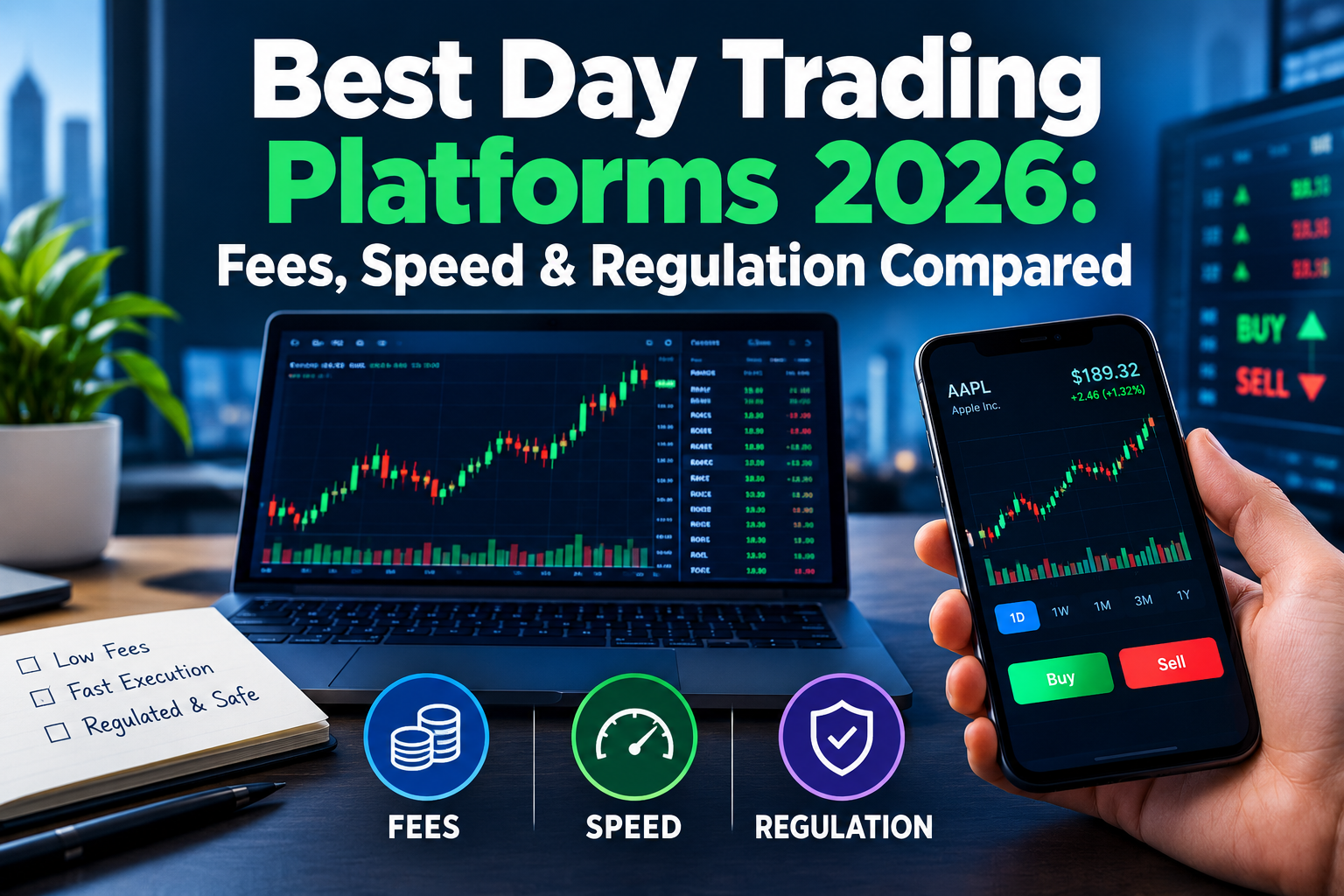
The best day trading platforms in 2026 combine low commissions, fast execution, advanced charting and reliable infrastructure. Interactive Brokers leads for active multi-asset traders, Webull offers the strongest commission-free package for US retail, Moomoo delivers the lowest overall trading costs, and TradeStation provides the deepest charting and automation tools. Charles Schwab’s thinkorswim remains the top choice for beginners who want research and education alongside execution capability.
Choosing the right platform matters more than ever. In April 2026, the SEC approved FINRA’s proposal to eliminate the Pattern Day Trader rule, removing the $25,000 minimum equity requirement that had restricted smaller accounts since 2001. The change took effect on June 4, 2026, replacing trade counting with real-time intraday margin standards. This fundamentally alters the competitive landscape, as platforms that once competed primarily on PDT-avoidance features now face a broader audience of traders who need genuine execution quality and risk management tools.
What to Look for in a Day Trading Platform in 2026
Day trading costs extend well beyond headline commissions. The total round-turn cost includes spreads, platform fees, market data subscriptions, margin rates and currency conversion charges. A platform advertising “zero commissions” may still impose costs through payment for order flow, wider spreads or elevated margin rates.
The metrics that matter most:
| Factor | Why It Matters | What to Check |
|---|---|---|
| Execution speed | Slippage directly reduces profit per trade | Direct market access (DMA) and smart routing availability |
| Commission structure | Per-share vs. per-trade pricing matters at volume | Tiered pricing thresholds and minimums |
| Margin rates | Borrowing costs compound quickly on leveraged positions | Benchmark-linked rates and tiered balance thresholds |
| Platform stability | Crashes during volatile sessions are costly | User reports on uptime during high-volume events |
| Regulatory coverage | Determines asset access and investor protection | SEC/FINRA, FCA, ASIC registration status |
| Market data quality | Real-time Level 2 data is essential for intraday decisions | Free vs. paid data; consolidated vs. non-consolidated feeds |
Direct market access (DMA) allows traders to execute orders without routing through a broker as an intermediary, which typically reduces latency. Among major retail platforms, Interactive Brokers, Lightspeed, Charles Schwab and TradeStation offer both DMA and smart routing, while Webull and Moomoo provide smart routing only.
Top Day Trading Platforms Compared
Interactive Brokers (IBKR): Best Overall for Active Traders
Interactive Brokers operates under nine tier-one regulators including the SEC, FINRA, FCA, and ASIC, and has been Nasdaq-listed since 2007. Its Trader Workstation (TWS) platform supports advanced order types, hotkeys, Level 2 quotes and scanners across more than 150 markets.
Cost structure (IBKR Pro):
- Stocks/ETFs: Tiered from $0.0035 per share, $0.35 minimum
- Options: $0.15–$0.65 per contract
- Futures: $0.25–$0.85 per contract
- Margin rates: As low as 4.58% on USD balances for IBKR Pro as of mid-2026
The IBKR Lite option offers $0 commission on US-listed stocks and ETFs for US residents, but uses payment for order flow. For serious day traders, IBKR Pro is the appropriate tier.
Consumer sentiment: Forbes Advisor’s Consumer Sentiment Index rated Interactive Brokers 6.0, with users valuing extensive market access and competitive fees but criticising the steep learning curve.
SIPC coverage: $500,000 on US accounts.
Webull: Best Commission-Free Platform for US Retail
Webull eliminated commissions on US equity day trades and pairs that with a mobile-first interface and free real-time market data. The platform offers zero-commission US stocks, ETFs and equity options with no account minimums.
Key features:
- Award-winning paper trading platform for strategy testing without capital risk
- Overnight 24/5 trading and extended hours access
- Crypto trading reintegrated into the main app
It uses payment for order flow, which means execution quality is not always optimal. Its consumer sentiment score of 6.2 reflects appreciation for the interface and charting tools alongside criticism of technical glitches and customer support.
Moomoo: Lowest Overall Trading Costs
Moomoo charges $0 commissions on stocks, ETFs and equity options, with no per-contract fee on equity options. Index options carry a $0.50 contract fee. The published US margin rate is 6.8% flat across balance tiers.
Forbes Advisor rated Moomoo as the best platform for low fees, citing its industry-leading margin rates and zero equity options commissions. The platform earned the highest Consumer Sentiment Index score at 6.6, with users praising the user-friendly interface and educational resources, though some raised concerns about data protection and system glitches.
Mobile app ratings: 4.4 (Android), 4.8 (iOS).
TradeStation: Best for Algorithmic and Systematic Traders
TradeStation’s proprietary EasyLanguage allows users to create trading algorithms through English-like syntax, enabling automated strategy execution. The TITAN X platform, launched in January 2026, offers customizable workspaces with symbol-linking, over 105 indicators, and multi-asset trading through a single order ticket.
Pricing:
- Stocks/ETFs: $0 online commissions
- Options: Per-contract pricing from $0.005 on tiered plans
- Futures: Competitive per-contract rates
TradeStation was quick to implement the new day trading rules, going live with the post-PDT framework on June 4, 2026.
Consumer sentiment: CSI score of 5.6, with users praising features and fast execution but reporting frustrations with technical issues and slow data feeds.
Charles Schwab (thinkorswim): Best for Beginners
thinkorswim, now integrated into Charles Schwab following the TD Ameritrade acquisition, remains one of the most capable retail platforms for traders who value research and education. Forbes Advisor named it the best day trading platform for beginners.
Features:
- Over 400 technical studies and charting tools
- Sophisticated strategy testing and simulated trading
- Native backtesting capabilities
Pricing:
- $0 online commissions for US-listed stocks and ETFs
- $0.65 per options contract
- Base margin rate of 10.00%, effective rate of 11.825% for debit balances up to $24,999
Schwab’s margin rates are notably higher than Interactive Brokers’, making it less cost-effective for traders carrying significant margin balances. The consumer sentiment score of 5.1 reflects concerns about technical difficulties and customer service.
Day Trading Platform Comparison Table
| Platform | Best For | Stock Commission | Options Fee | Margin Rate | DMA | CSI Score |
|---|---|---|---|---|---|---|
| Interactive Brokers | Active multi-asset traders | $0.0035/share (Pro tiered) | $0.15–$0.65/contract | From 4.58% | ✔ | 6.0 |
| Webull | Commission-free US retail | $0 | $0 | Competitive | ✘ | 6.2 |
| Moomoo | Lowest overall costs | $0 | $0 (equity) | 6.8% flat | ✘ | 6.6 |
| TradeStation | Algo and systematic traders | $0 online | From $0.005/contract | Competitive | ✔ | 5.6 |
| Charles Schwab | Beginners and education | $0 | $0.65/contract | 10.00% base | ✔ | 5.1 |
CSI = Forbes Advisor Consumer Sentiment Index (out of 10)
The 2026 Regulatory Shift: PDT Rule Eliminated

The most significant structural change to day trading in decades occurred in 2026. FINRA’s proposed rule change to amend Rule 4210 replaced the Pattern Day Trader framework — including the $25,000 minimum equity threshold and day-trade counting mechanics — with a modern intraday margin standard.
Timeline of the change:
| Date | Event |
|---|---|
| January 2026 | FINRA files proposed rule change (SR-FINRA-2025-017) |
| February 4, 2026 | Public comment period opens |
| April 14, 2026 | SEC grants accelerated approval |
| April 20, 2026 | FINRA publishes Regulatory Notice 26-10 |
| June 4, 2026 | Rule becomes effective |
| October 20, 2027 | Phase-in period ends |
The new framework requires real-time intraday margin calculations rather than counting day trades within a rolling five-day window. Brokers must either implement real-time controls to prevent intraday margin deficits or use a single end-of-day computation. The general $2,000 minimum equity requirement for margin accounts remains in place.
Brokerages responded quickly. Robinhood and Webull began implementing changes immediately after the effective date, while Schwab planned rollouts starting June 8. Robinhood shares rose 7.8% on the day of the SEC’s approval and more than 30% for April as investors anticipated higher trading volume from smaller accounts.
How to Choose the Right Day Trading Platform
The decision depends on three primary factors: what you trade, how often you trade, and how much capital you deploy.
For high-volume US equity traders: Interactive Brokers Pro tiered pricing becomes the cheapest option at scale ($0.0035 per share at top tier), and its DMA capability reduces slippage on large orders.
For commission-sensitive retail traders: Webull and Moomoo both offer $0 commissions on stocks and equity options. Moomoo edges ahead on margin rates (6.8% flat vs. Webull’s competitive but variable rates).
For options-focused traders: tastytrade is the specialist choice, with a multi-leg ticket designed for complex strategies and commissions that undercut IBKR Pro at high volumes.
For futures traders: NinjaTrader offers the lowest credible intraday margins for US futures, with day-trading margins from $50 per micro contract.
For algorithmic traders: TradeStation’s EasyLanguage remains the most accessible strategy-automation language in retail trading.
For beginners: Charles Schwab’s thinkorswim provides the deepest educational resources and paper trading environment, though higher margin rates make it less cost-effective for leveraged strategies.
Key Facts
| Metric | Detail |
|---|---|
| PDT Rule Status | Eliminated June 4, 2026 |
| Minimum margin account equity | $2,000 (retained) |
| Average daily options transactions (2025) | 8.4 million, up 50% from 2023 |
| Median retail trader loss (6 months) | 36% of capital |
| Day traders who quit within 2 years | 94% |
| Robinhood share price change on PDT approval | +7.8% |
Sources: FINRA CAT data, Forbes, Gitnux/Report 2026
Expert Insights

Execution quality matters more than headline commissions. Zero-commission platforms using payment for order flow may route orders to market makers who provide inferior fills. For active day traders, the difference between a $0 commission and a $0.0035-per-share commission can be smaller than the cost of one tick of slippage on a poorly executed order. Interactive Brokers’ IBKR Pro tier and TradeStation both offer direct market access, which gives traders more control over execution.
The post-PDT landscape rewards risk management. Removing the $25,000 threshold does not change the statistical reality that most retail day traders lose money. FINRA data shows the median retail trader loses 36% of capital within six months, and 94% quit within two years. The new intraday margin standards require brokers to monitor risk in real time, but individual traders bear the ultimate responsibility for position sizing and stop-loss discipline.
Margin rates deserve more attention. A trader carrying a $50,000 debit balance at Interactive Brokers’ 6.33% effective rate pays roughly $263 per month in interest. At Schwab’s 11.825% effective rate, the same balance costs $493 per month. Over a year, that difference exceeds $2,700 — often more than the commission savings from a “free” platform.
Read More: Peter Mandelson: Career, Controversies, and Current Investigations’ News in 2026
Frequently Asked Questions
What is the best day trading platform for beginners in 2026?
Charles Schwab’s thinkorswim platform is the strongest choice for beginners, offering over 400 technical studies, native backtesting, simulated paper trading and extensive educational resources at no platform cost. For beginners prioritising low costs, Webull’s paper trading sandbox provides a risk-free environment to test strategies before committing capital.
Which day trading platform has the lowest fees?
Moomoo offers the lowest overall cost structure with $0 commissions on stocks, ETFs and equity options, plus a flat 6.8% margin rate. Webull matches the zero-commission structure for US equities and options. Interactive Brokers Pro becomes the cheapest option for high-volume traders, with tiered pricing dropping to $0.0035 per share at the highest volume tier.
Is the $25,000 day trading rule still in effect?
No. The Pattern Day Trader rule was eliminated effective June 4, 2026, following SEC approval of FINRA’s proposed rule change. The $25,000 minimum equity requirement no longer applies to margin accounts. Brokers now use real-time intraday margin calculations instead of counting day trades. A general $2,000 minimum equity requirement for margin accounts remains in place.
Which platform is best for options day trading?
tastytrade is the specialist choice for options day traders, with a multi-leg order ticket designed for complex strategies and commissions that undercut Interactive Brokers Pro at high volumes. Interactive Brokers offers broader market access and is the better choice for traders who need stocks, options and futures in a single account.
Do I need direct market access for day trading?
Direct market access is not strictly necessary, but it provides meaningful advantages for active traders. DMA reduces latency by routing orders directly to exchanges or market makers rather than through a broker’s internal system. Interactive Brokers, TradeStation, Charles Schwab and Lightspeed all offer DMA. Webull and Moomoo rely on smart routing without direct access.
What margin rate should I expect from a day trading platform?
Margin rates vary significantly. Interactive Brokers offers the lowest published rates, from 4.58% on USD balances for IBKR Pro as of mid-2026. Moomoo offers a flat 6.8% across all balance tiers. Charles Schwab’s base rate is 10.00% with an effective rate of 11.825% on balances under $25,000. Always verify current rates directly with the broker, as they are benchmark-linked and change with interest rate conditions.
Conclusion
The best day trading platforms in 2026 depend entirely on your trading style, volume and asset class. Interactive Brokers remains the most complete package for active multi-asset traders, combining the lowest margin rates, direct market access and global reach across more than 150 markets. Webull and Moomoo serve cost-conscious US retail traders with zero commissions and competitive execution. TradeStation delivers the deepest charting and automation tools for systematic traders. Charles Schwab’s thinkorswim offers the strongest educational foundation for beginners.
The elimination of the Pattern Day Trader rule in June 2026 removed a significant barrier to entry, but it did not change the fundamental risks of intraday trading. Whether you choose Interactive Brokers for its institutional-grade infrastructure, Webull for its commission-free simplicity, or TradeStation for its algorithmic capabilities, the platform is only as effective as the risk management discipline behind it. Start with paper trading, track your actual round-turn costs, and let execution quality — not marketing — guide your final decision.